
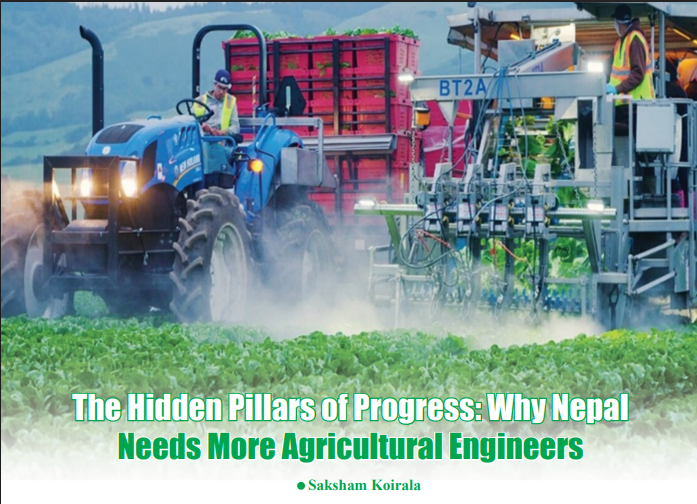
Agricultural engineering is the educational and professional application of engineering design and scientific concepts to farm production, combining various civil, mechanical, electrical, food science, and engineering disciplines to optimize the productivity of farms and agribusiness enterprises, and to render natural and renewable resources sustainable.
It involves farm machinery, irrigation, post-harvest engineering, renewable energy, soil and water conservation, and rural infrastructure. Agricultural engineers improve farming to be more efficient, resilient, and sustainable.
This is a discipline that is taught in more than 70 countries in the World, USA, Germany, India, Brazil, Australia, China etc. Investments in agricultural engineering are being made by these countries so as to make the process of farming more mechanical and in a bid to attain food security and to fight climate change. In Nepal, only the Purwanchal Campus, Dharan of the Institute of Engineering (I.O.E). already offers Agricultural Engineering.
There exists a fair level of emptiness even though its relevance is increasingly becoming high. Nepal has less than 50 agricultural engineers every year, way below the national demand. Agricultural engineering students encounter numerous issues, whether it is less recognition in comparison with other branches of engineering or lack of employment and low recruitment in the state. Among such challenges, a low level of general awareness and knowledge of the discipline seems to be the primary one. It also has a misconception among the people that B.E. in Agricultural Engineering and B.Sc. Agriculture are synonymous and the actual fact is that B.E. in Agricultural engineering deals with the concepts of machinery, irrigation, rectifications and structures, energy, soil, and water conservation through utilizing AutoCAD and GIS software, structural designing, and mechanical tools. Unlike B.Sc. Agriculture, which is concerned with crops, soil science/plant pathology, entomology, extension through crop planning tools, etc. Such a misconception not only tends to influence the ordinary citizens but also influences the selection of students, official hiring, and funding interests of the government.
Even today, Nepal remains an Agrarian Nation in which 62 percent of households are engaged in agriculture and 67 percent of the population resides in farming households (National Agricultural Census 2021/22). Nevertheless, the agriculture sector remains mechanized by only approximately 60%, mostly in the terai region, where hills and mountains indicate only 2-15% mechanization. Farmers with access to meaningful use of machines remain at the level of only 20-25%, with tilling the major part of machinery (transplanting, weeding, and harvesting is still done by hand. Poor mechanization leads to costly labor as well as food imports.
The job of the agricultural engineer is in the area of mechanization, mini tiller, hand tools, small horsepower tractors in rugged topography in the hills, solar power pumps, the drip and gravity irrigation system in access restricted areas to irrigation, dryers, storage and packaging means of post-harvest waste, etc. High levels of mechanization among all regions have been catalyzed by localization of tractors and threshers in Terai by engineers. Due to engineering innovation, experience, and trial in the field, mini-tillers and solar pumps were introduced in hills.
National sides such as Prime Minister Agriculture Mechanization Projects (PMAMP) include the involvement of engineers in the planning, monitoring, and evaluating of Agri-division zones, and other research centers such as Nepal Agriculture Research Council (NARC) also engage the help of Agricultural engineers to carry out research and development.
We can talk about the important role of Agricultural Engineers in the Development in Nepal which would be that, agricultural engineers assist in modernization of Traditional Farming such as custom tools, hill suitable machines and also agricultural engineers can be used to assist in improving irrigation and water management through designing and construction of drip, sprinkler irrigation systems. In facilitating the processes of mechanization in an area, depending upon the area and demands, soil and water protection through planning experienced terraces, drop structures, erosion control means, post-harvesting technology etc. Mechanization and modernization in the country of Nepal today is stated as a directive in showing where and how agricultural engineers have been engaged.
In places such as the terai, which have high rates of mechanization, engineers have been more than active in trying to test, localize, and spread farm technologies. Simultaneously, this low degree of mechanization of the hilly areas tells us how urgent there is a need of more engineers, more agricultural research, and more focus in the attention.
Concisely, there can be no mechanization of Nepal unless there are agricultural engineers in the country. Agricultural engineers are the pioneers of change in Nepal rural areas. Still, these are not used. Nepal needs to acknowledge, invest and market this field of study, this career to create a sustainable future of agriculture. The nations such as USA are developing precision agriculture, Agriculture connected to Artificial Intelligence, Technology in farms, and so many more inventions. In Nepal, the Agricultural Engineers are still struggling to survive and are fighting to have a spot.
Agricultural engineering in Nepal is not only one subject but also a dream which is to be respected, recognized and rebuilt again. However, the sad situation is that a lot of students choose this course not because they want it but because they do not have another chance. They are looked down upon by engineers, ignored in national schemes, as well as, academic concerns. However these same students are the unsung heroes of today who are at work to empower our farmers, to safeguard our soils, to conserve our water and to mechanize our land. They are the redoubtable out-of-the-sight hero of marrying agriculture and technology by bridging the gap between farmlands and national development.
With more than two-thirds of the population being dependent on agriculture in the country in question, one simply cannot afford to overlook agricultural engineers, who come close to being the foundation of our economy, and food security. To be able to develop Nepal, we first have to develop agriculture and to achieve this, we need to empower hands and minds of agri-engineers.
“Agricultural engineers don’t just cultivate land—they cultivate the future of the nation.”
“जय कृषि”